

For businesses of all sizes, 90-day trial periods are a really effective tool for assessing new employees to see if they are suitable for a role. They also provide the employer some protection from personal grievance claims.
However, for a 90-day trial period to be valid, there are some clear legal requirements that have to be met, such as including a trial period clause in the employment agreement and only utilising them for employees who haven’t worked for the business before.
We frequently see employers making errors with 90-day trials, whether they misunderstand the rules or don’t pay enough attention to good faith and proper procedure. These mistakes can lead to successful personal grievance claims for unjustified dismissal, which can cost tens of thousands of dollars in compensation and fines.
In this article, we look at how 90-day trial periods work, how your business can set up and run legally-enforceable trial periods, and what to do if you need to terminate someone’s employment during the trial period.
What are 90-day trial periods in New Zealand?
90-day trial periods allow employers to assess a new employee's suitability for a role, based on their performance, conduct, attitude etc. within a defined period.
All trial periods must be included in and agreed to by the employee as part of the employment agreement, as they are a voluntary provision and don’t automatically apply to every new employee.
90-day trials can last for up to the first 90 calendar days of employment, but cannot be extended beyond 90 days.
Trial periods can be used for all new employees, as long as they have not been employed with the company before. This means you cannot utilise them for existing employees starting a new role but you can use them for new employees that you’ve previously "engaged" in a different capacity, e.g. as a contractor or temp.
Remember, employees include all casual, permanent, and fixed-term staff. Independent contractors are not employees.
You cannot use a 90-day trial period for people on certain work visas, e.g. an Accredited Employer Work Visa.
What protection does a 90-day trial period give an employer?
Employees on a valid 90-day trial period are unable to raise a personal grievance related to dismissal (either unjustifiable dismissal or unjustifiable disadvantage that relates to the dismissal), as long as the termination was managed fairly and in accordance with the law governing 90-day trial periods.
Employees can still raise a grievance on other grounds, such as for unjustified disadvantage (e.g. you failed to provide training or the opportunity to improve), harassment, discrimination, or if the trial period itself is invalid.
All other conditions of employment (e.g. acting in good faith) and minimum entitlements around pay, conditions, leave, and health and safety are not affected by the trial period.
Legal requirements for a valid 90-day trial period
- The 90-day trial period and its length must be clearly stated in the employee’s employment agreement.
- You must give the employee ‘fair and reasonable time’ to review their agreement and seek advice prior to starting work. We recommend a minimum of 2 working days.
- Both parties need to sign the employment agreement prior to the employee’s start date (it can’t be on their first day of work or afterwards).
- The person cannot have worked for you before - make sure your recruitment processes include checks that there are no pre-existing employment relationships, e.g. if the company had a different owner previously or you had the employee perform a paid work trial.
What if I can’t use a trial period?
In the circumstance that you can’t include a 90-day trial period in the employment agreement (e.g. if the employee already works for you or has worked for you before), you may be able to use a probationary period instead.
Probationary periods are similar to 90-day trial periods but do not offer the same protection from personal grievances for unjustified dismissal. They can be for any length of time (so long as it is fair and reasonable) and the employee agrees. They can also be extended, as long as both parties agree.
Note: You can't put an employee on a probationary period after a trial period. If you haven’t given the employee notice by the end of the trial period, then the trial period expires and their employment continues as usual.
How to run a legally sound 90-day trial period in New Zealand
- Ensure your recruitment process is solid - Give yourself the best chance of getting the right person for the role and the organisation. This includes doing your due diligence, like reference checks, making sure they have the right qualifications, and doing your best to make sure they have the right skills for the role.
- Have a robust trial period clause in the employment agreement - This is where the employee agrees to take the job subject to a 90-day trial period – it can be useful to remind them of this if problems arise. Telling somebody verbally that there is a trial period is not enough.
- Implement a well-structured onboarding process - Provide support and training, set regular review meetings, give detailed feedback, and document the process. Don't let things lie; address any issues (even minor ones) early so new people know where they stand and what success looks like. We recommend using performance reviews for all staff so you can set clear objectives, track and discuss progress, and objectively evaluate achievement.
- Treat the person as you would any other employee - This means being fair, providing all entitlements and clear direction, and giving them the opportunity to improve.
- Raise performance concerns early - If there are issues that may lead to termination, make it clear that the employee may be dismissed if they don't improve. This might feel uncomfortable, but if it’s not made crystal clear to the employee that their job may be on the line, then you may be challenged when it comes to dismissal.
MyHR's Chief Evangelist, Sylvie Thrush Marsh, explains the ins and outs of Trial Periods.
Common mistakes that invalidate a 90-day trial period
- Employment agreement isn’t signed before the employee starts work - The employment agreement must be signed by both parties before the employee begins work, including any paid or unpaid trial shifts, orientation, or training.
- The trial period clause is badly written - If you don’t have a clause in the employment agreement that clearly sets out the terms of the 90-day trial period, its length, the employer's ability to dismiss during it, and the protection from personal grievances for unjustified dismissal, it may not stand up if challenged. The agreement also can’t have other clauses that conflict the terms of the trial (or vice versa).
- Employee has been previously employed -: The employee must be genuinely new to the business. If the person has been employed previously in any capacity (even if it’s just a paid work test or trial shift), the trial provision could be ruled invalid.
- "Instant" dismissal - Even with a valid 90-day trial period in place, you can’t fire someone on the spot. You must provide the employee with the correct notice as stipulated in their employment agreement.
- Not acting in good faith - A trial period isn't licence to ignore the regular employment obligations. Employers must act in good faith, raise performance concerns, and give the employee a reasonable opportunity to improve and seek independent legal advice.
How to legally terminate employment during a trial period
If you want to end a person’s employment while they are on a valid 90-day trial period, you don’t need to provide a reason for doing so.
However, good faith obligations still apply, so you should meet with the employee privately to explain why they haven’t met your expectations and be prepared to listen to their side of the story.
Dismissal process map
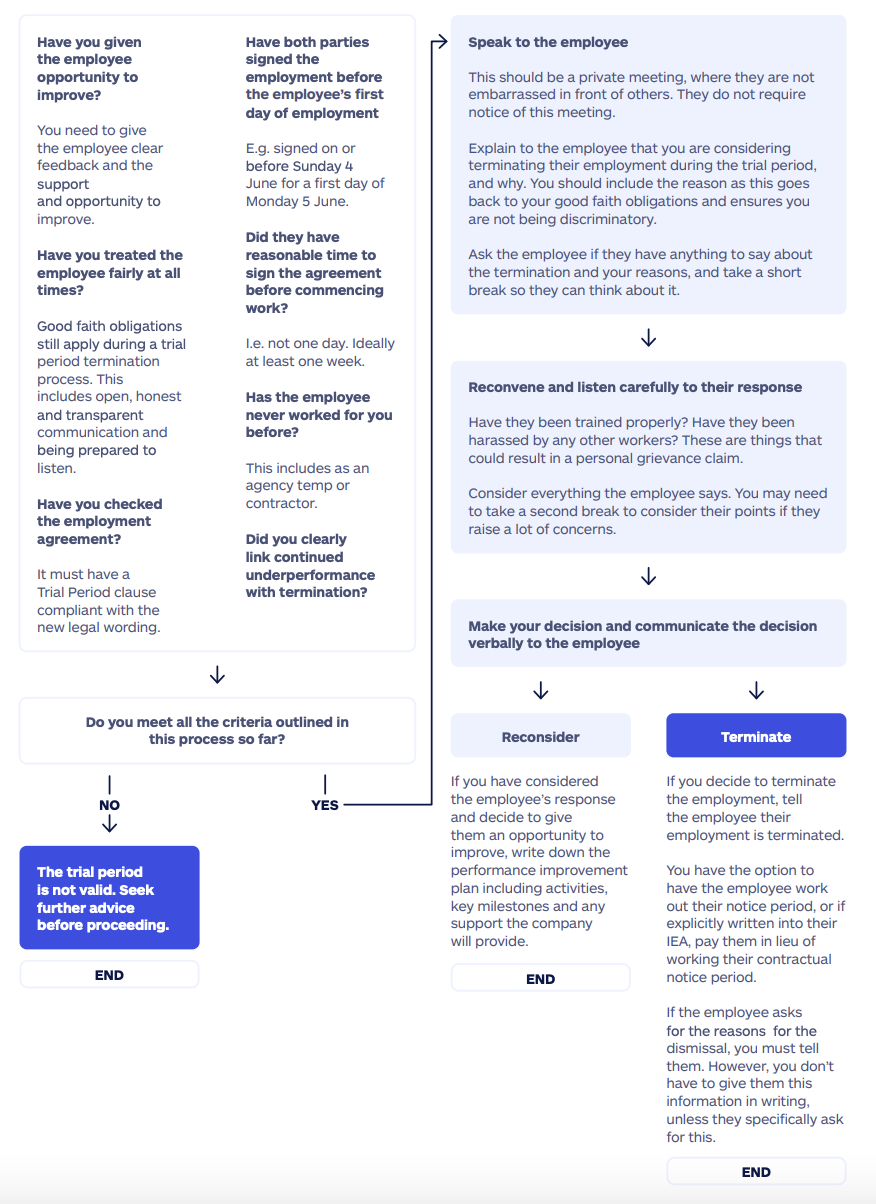
It may be that they haven’t been trained properly or have suffered harassment from other workers.
If you still decide to dismiss the employee, tell them their employment is terminated. If they ask for the reasons for the dismissal or want it put in writing, you need to give that to them.
You must give the person the correct amount of notice, so there are no “instant dismissals” during a trial period. Depending on the terms of their employment agreement, you may have the option to pay them in lieu of working their contractual notice period.
If you decide to give them an opportunity to improve, create a performance improvement plan that includes activities, key milestones, and any support you will provide.
How MyHR can help
If you need help setting up legally enforceable 90-day trial periods or you're considering terminating an employee on a trial period and want to be sure you've followed all the necessary requirements, get in touch with MyHR. Our powerful software makes hiring and onboarding employees easy and our team of HR experts is here to help with any employment-related issue or process.

![shutterstock_608860169 [Converted]-01](https://blog.myhr.works/hubfs/shutterstock_608860169%20%5BConverted%5D-01.jpg)